Getting six extra rows of crops from the same piece of land changes the math of farming.
For Iván Briseño, an operator at TMAC in Mexico, this is not a theoretical calculation. As a farm owner who also gets behind the wheel, he needs technology to make the work easier in the cab and improve the numbers behind the business.
At TMAC, those losses became measurable. Iván reports six extra planting rows per hectare and, in one field comparison, seven more tons of crop than a neighboring operation not using auto steering.
But that result did not come from a single installation. It grew from a four-year journey with precision agriculture in Mexico, supported by Sveaverken and local dealer Proinova.
The Pressure to Produce More Without Spending More
TMAC provides agricultural contracting services and produces grains and vegetables in Mexico. Every pass carries a cost. Diesel, working hours, field capacity, and crop output all affect the final margin.
“Agriculture requires us to become more efficient,” Iván says. “We have to produce more and reduce costs.”
Before adopting precision agriculture, TMAC depended more heavily on the operator to keep each pass aligned. Experience helped, but small inconsistencies still added up. TMAC needed to use its existing tractors and fields better without adding more strain on the operator.

Starting with Auto Steering, Then Building Further
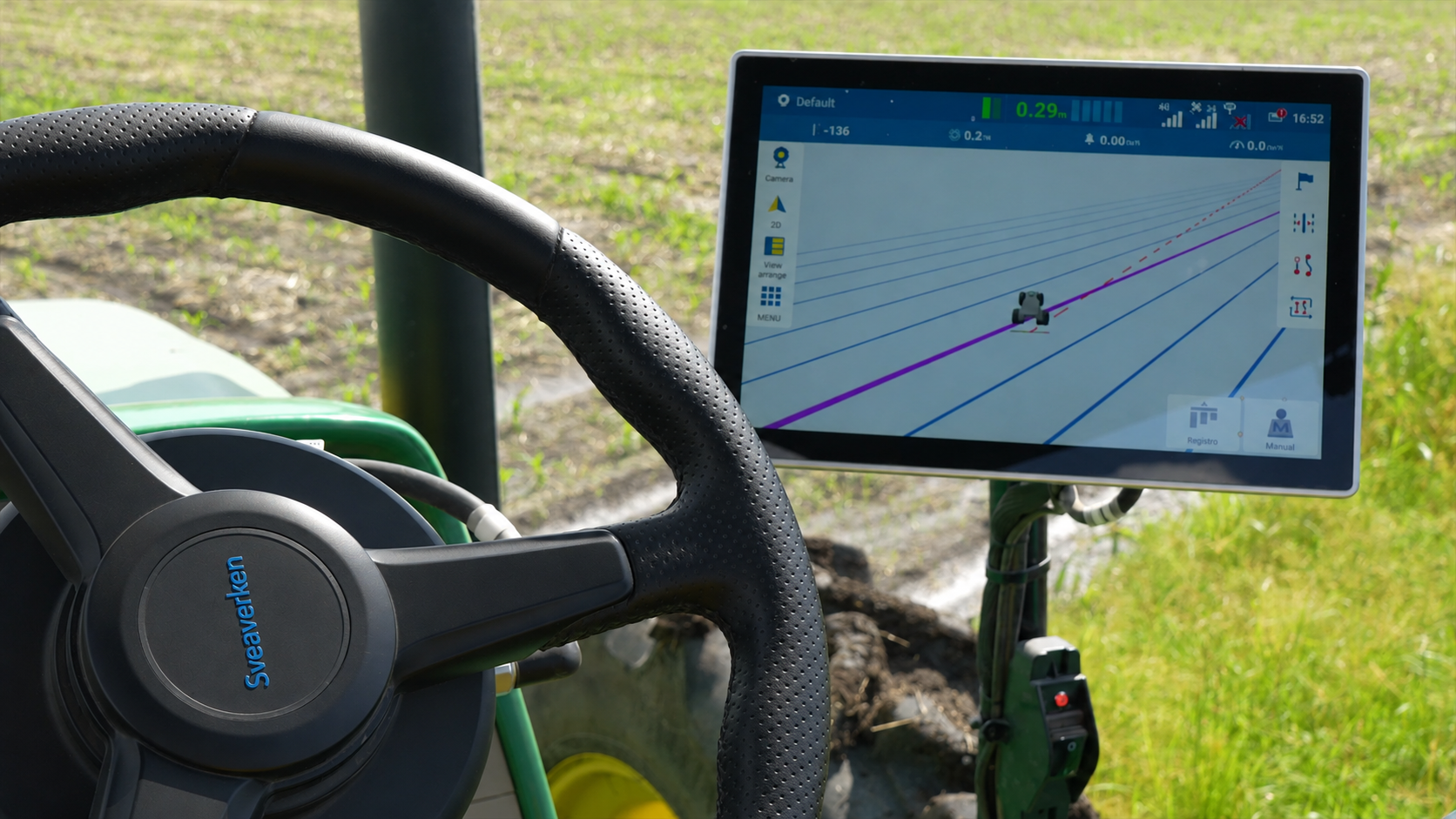
The journey began around four years ago with the Sveaverken F100 Auto Steer System, supplied and supported by Grupo Agroindustrial Proinova S.A. de C.V..
The team started with auto steering, tested it through real fieldwork, and learned where precision could create the most value.
After seeing the system work, TMAC upgraded to the Sveaverken F200 Auto Steer System. The operation later added a combined setup that brings auto steering and the F200L 3D Land Leveling System into one workflow.
Each step solved a practical problem. Auto steering helped the tractor follow planned paths more consistently. Land leveling added control over the field surface. Together, they addressed both how the tractor moved and how the land was prepared.
Six More Rows from the Same Hectare
Small variations between passes can leave land unused or reduce the number of rows that fit within a field. Auto steering helped TMAC maintain more consistent spacing and make fuller use of the available width.
Iván tracks the operation closely on a per-hectare basis. According to his experience, the system allowed TMAC to plant six additional rows per hectare.
“No matter how experienced the operator is, the precision of the system gave us six extra rows per hectare during planting,” he says.
Across the three-hectare plot discussed in the interview, six more rows per hectare became approximately 18 additional rows. Iván reports that these extra rows contributed to seven more tons of crop compared with a neighboring operation that was not using auto steering.
He also estimates that the wider use of precision agriculture has supported a 20% to 30% increase in production at TMAC while helping reduce diesel consumption and working time.
The figures are specific to TMAC's fields, crops, equipment, and working conditions. Their importance lies in what they reveal: a small improvement in each pass can become a meaningful business result when repeated across a field and a season.

Then the Rain Put the Field to the Test
The planting results proved the value of better guidance. Heavy rain tested another part of the solution.
When heavy rain arrived, flooding became a concern. But Iván says the fields prepared with the combined auto-steering and land-leveling setup drained naturally.
“Because we had properly leveled the fields, we did not have to lose sleep worrying about flooding,” he says. “The water drained naturally, and that gave us a lot of peace of mind.”
The auto steer system guided the tractor along the planned direction, while F200L managed the leveling work. The result was not simply a smoother-looking field. It was a surface that handled heavy rain more effectively.
For Iván, that peace of mind became another form of return on the investment.

Support When the Work Cannot Wait
The best field technology still creates risk if the customer has nowhere to turn when a question arises.
Throughout TMAC's journey, Proinova remained the local link between the customer and Sveaverken. Its team supported the move from F100 to F200 and the later adoption of the combined auto steering and land leveling solution.
When TMAC needs help, Iván says support is available by phone, video call, or in person. That access matters when equipment is already in the field, and the working window is short.
Local support helped TMAC learn each system, solve problems as they appeared, and add new capabilities with greater confidence.

A Four-Year Story Measured in the Field
TMAC's journey began with F100, moved to F200, and developed into a coordinated auto steering and land leveling workflow. Iván describes six more planting rows per hectare, lower fuel use, fewer working hours, better drainage after heavy rain, and support that remains close to the operation.
Seven additional tons made the value visible in one field comparison. The larger story is how TMAC learned to make better use of its land, machinery, and every pass across four years of real work.
Could the same approach help your operation make more of every hectare? Contact us to explore a precision agriculture solution for your tractors, fields, and working needs.